


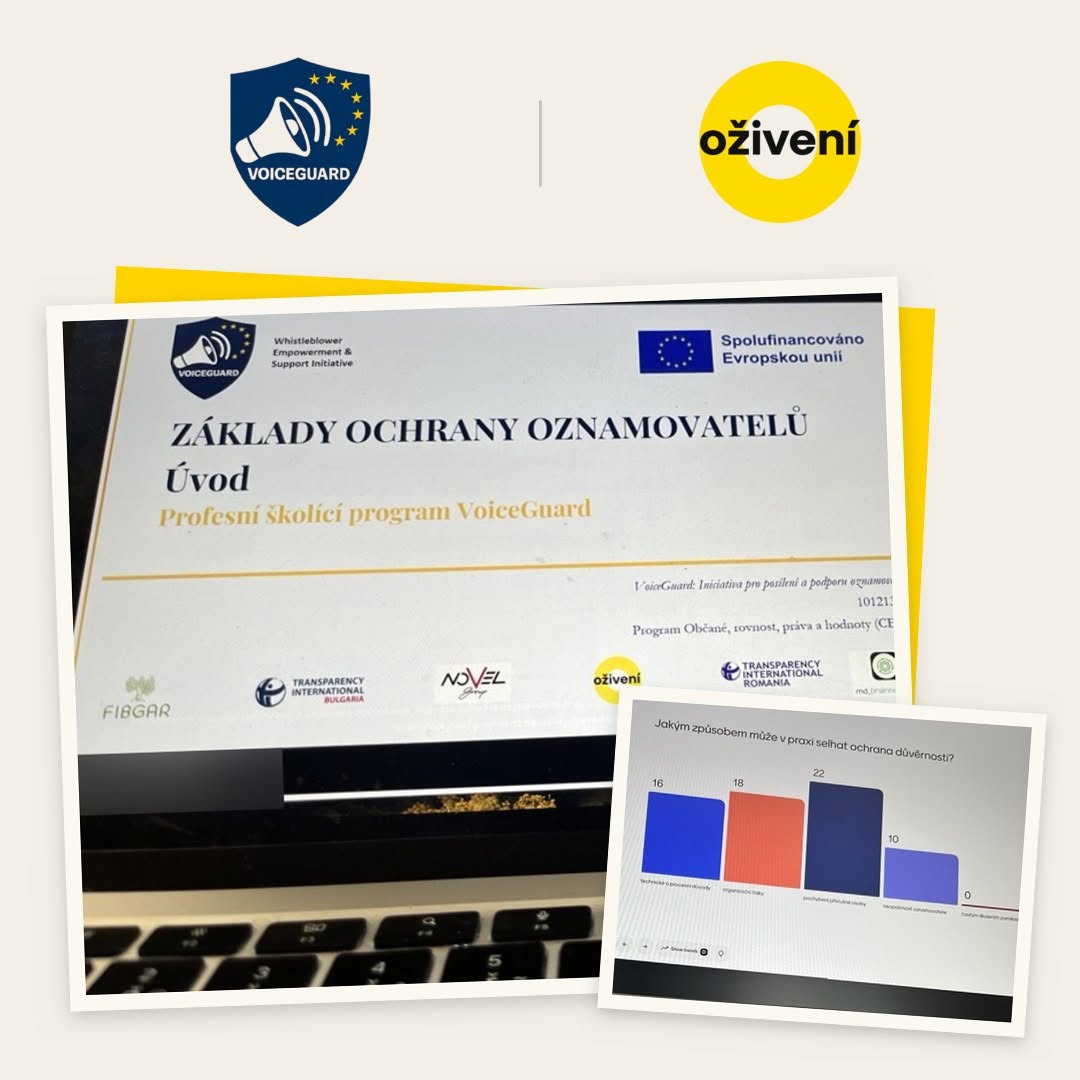
On 24–25 September 2026, Oživení organised a two-day online VoiceGuard seminar for approximately 40 professionals working in Czech organisations on whistleblower protection and the operation of internal reporting systems. Participants included representatives of public administration, compliance, legal practice and HR – people who directly receive and handle reports.
The main aim of the seminar was not only to verify whether an organisation has formally established a reporting system, but whether employees can genuinely trust it and whether the organisation is able to respond safely when a report is actually made. The first day therefore focused on organisational silence, trust, confidentiality, retaliation and the initial assessment of reports. The second day concentrated more on the practical set-up of the system, self-assessment and concrete opportunities for improvement.
It was the practical part that generated the greatest interest. Participants worked with model scenarios, investigation checklists, a retaliation risk assessment tool and an organisational self-assessment matrix. The greatest attention was given to step-by-step procedures for handling a specific report – from triage and investigation planning to communication with the whistleblower. The discussion repeatedly returned to questions of how to proceed when people are unwilling to cooperate, how to respond to resistance from management, or how to protect the person handling the case.
The dynamics within the group were also interesting. Given the participants’ professional roles and the sensitivity of the topic, people were initially relatively cautious about openly sharing their experiences. However, once someone brought in their own experience, others gradually began to contribute as well. This showed that, alongside legal knowledge, the opportunity to safely exchange experiences among people dealing with similar situations in different organisations is also crucial for effective whistleblower protection.
The Czech seminar also once again showed that the biggest challenge is often not creating an internal reporting channel itself, but ensuring that it works in the real organisational environment. Participants highlighted, for example, the importance of management support, cooperation between the person responsible for handling reports, internal audit and other colleagues, and the gap between formally established rules and what can actually be implemented within an organisation.