

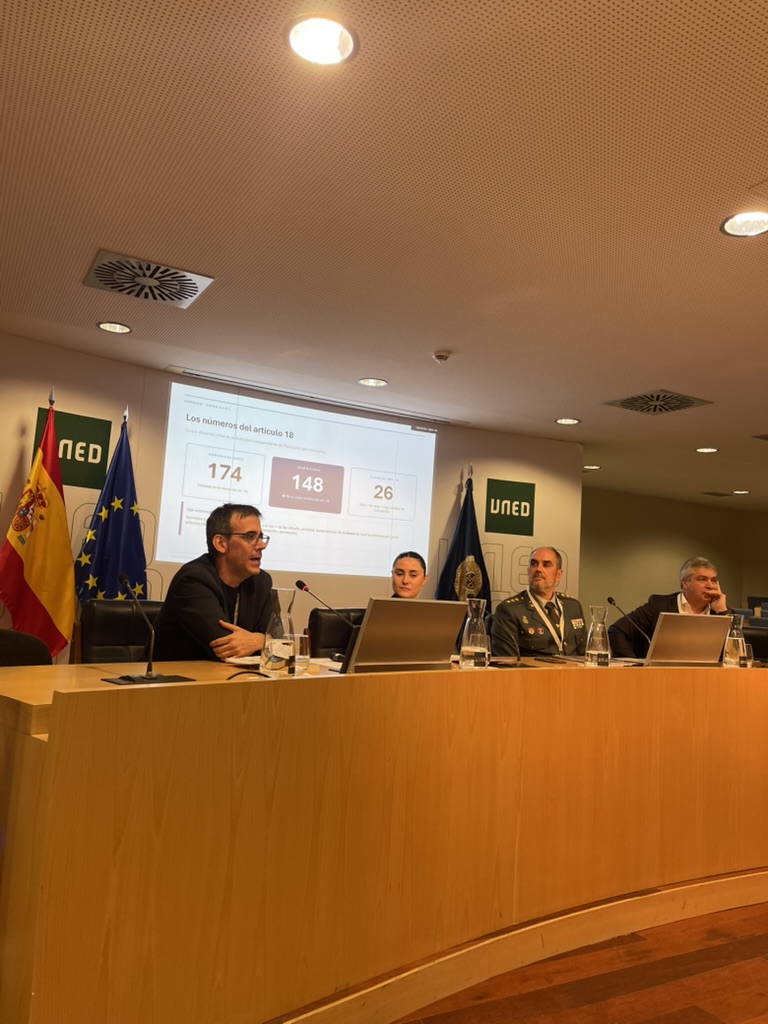
Carmen Coleto, project manager at FIBGAR, took part this week in the 2nd Congress on Integrity and Whistleblower Protection, held at the UNED Faculty of Education in Madrid. Representing the consortium, she presented the main findings of the Needs Analysis for the VoiceGuard project, co-funded by the European Union through the Citizens, Equality, Rights and Values (CERV) Programme.
VoiceGuard was created to address a well-known structural problem in the field of public integrity: fragmentation and inconsistencies in the transposition of Directive (EU) 2019/1937 result in a radically unequal protection framework depending on the Member State in which the whistleblower is located. The six countries analysed have transposed the Directive with delays and varying approaches. All require internal reporting channels for organisations with 50 or more employees, but differ in their approach to anonymity — Spain, Greece and Romania allow it; the Czech Republic restricts it —, in the applicable sanctions, in the supervisory authorities and in the scope of protection. This heterogeneity is not a mere detail: it directly influences the strategies adopted by whistleblowers.
The presentation outlined the findings of the project’s first major deliverable: the Needs Analysis, drawn from in-depth interviews with sixteen whistleblowers across six Member States and focus groups with thirty-two support professionals—lawyers, psychologists, judges, civil servants and civil society representatives—supplemented by a quantitative validation questionnaire.
The conclusions are compelling. For the majority of those interviewed, reporting an irregularity is not a matter of isolated bureaucratic failures: it is professional annihilation, psychological trauma and systemic neglect. The data reveal three recurring patterns that operate regardless of the country analysed.
The first finding concerns the period leading up to the whistleblowing. The decision to blow the whistle rarely results from a reflective process in a safe environment. The dominant motivations are a refusal to be complicit in illegal activities and the perception that silence equates to complicity. However, two prior obstacles block this impulse: a structural information gap — many whistleblowers are unaware of their rights and the available channels — and a generalised mistrust of internal whistleblowing mechanisms, which are perceived as aligned with the organisation’s management. The hypothesis is confirmed: an environment of trust and the structural independence of the channel are not merely desirable attributes of the system, but preconditions for the report to be made. Without them, the internal channel is perceived as a trap.
When a report is made, the ‘black hole’ phenomenon emerges: reports are submitted but receive no acknowledgement, generate no active follow-up and produce no feedback. Most respondents describe this silence as the defining experience of the process: ‘Everything disappears into a black box… From my point of view, it was silence.’ Half of the participants resorted to multi-channel whistleblowing, not as a strategy, but because no channel was responding. In some cases, passive obstruction escalated to active interference: for example, blocking access to corporate email to prevent the documentation of irregularities. Experts from multiple jurisdictions are unanimous: the whistleblowing process, which should be a safe haven, becomes the first stage of retaliation. This is not administrative negligence; the experts themselves describe it as deliberate procedural hostility.
Retaliation rarely consists of an isolated dismissal. It is a calculated, three-stage strategy: discrediting — misrepresenting compliance with regulations as insubordination, fabricating disciplinary sanctions, portraying the whistleblower as ‘problematic’ —; isolate —‘fear of contagion’ leads colleagues to marginalise the whistleblower through exclusion from meetings, collective harassment and gaslighting—; and destroy —dismissal following a campaign of harassment, inclusion on professional blacklists and severe psychological harm—. The legally crucial point is this: these subtle tactics fall into a regulatory vacuum and the legal system does not recognise them as reprisals.
The third pattern reveals a critical time lag: the protection framework relies on corrective measures taken after the event, yet retaliation is immediate and the legal response takes years. By the time a judgement is handed down, the professional, financial and psychological damage is already irreversible.
In light of this analysis, the data from Luxembourg offers a key conclusion: failure is not inevitable. In that jurisdiction, 80% of whistleblowers felt their report was handled professionally, 100% saw concrete changes, and 60% felt protected. This demonstrates that the problem is not structural, but cultural and institutional, and is therefore reversible.
The presentation generated considerable interest among those in attendance. FIBGAR has received, both on the day of the presentation and in the days since, various requests for information about the project and the report from legal professionals, institutional representatives and civil society organisations interested in the results and the possibilities for future collaboration.
This interest confirms the relevance of the work carried out by the consortium and the need to continue making progress in building a European ecosystem that provides real protection for whistleblowers.
Carmen Coleto Martínez, Junior Project Manager at FIBGAR